

LightForce Orthodontics: Are Custom 3D-Printed Braces Actually Worth It?
You’re comparing orthodontic options, and suddenly everything starts to sound a bit confusing.
Traditional braces are reliable. Invisalign sounds convenient. Ceramic braces look less noticeable. Then you hear about LightForce orthodontics, a newer system that uses custom 3D-printed braces.
At first, it may sound like another “high-tech” dental product.
But the real question is not:
“Is LightForce new?”
The real question is:
“Does LightForce actually change the treatment process enough to matter?”
That is the question this guide will answer.
LightForce orthodontics is a digital braces system where the brackets are designed from the patient’s own tooth anatomy and the orthodontist’s treatment plan. Instead of starting with standard brackets made for average tooth shapes, LightForce starts with a digital plan and then creates custom brackets for that specific patient. LightForce describes its brackets as being generated from the doctor’s treatment plan, including details such as the bracket base, slot, prescription, position, tie wings, and hooks.
So the value is not simply “3D printing.”
The value is that more of the orthodontist’s plan is built into the braces from day one.
Quick Answer: What Is LightForce Orthodontics?
LightForce orthodontics is a personalized braces system that uses digital planning and custom 3D-printed brackets.
In simple words, it is not the same bracket design for every patient.
With traditional braces, the orthodontist usually starts with standard brackets and then fine-tunes the treatment over time. With LightForce braces, the orthodontist creates a digital plan first, and the brackets are made for the patient’s teeth and planned tooth movements.
This can matter because tooth shape, bite problems, crowding, rotations, and smile goals are different for every patient.
LightForce is not usually chosen because it is the cheapest option. It is also not mainly chosen because it is “invisible.” The stronger reason to consider LightForce is that it may make fixed braces treatment more personalized, more digitally planned, and more efficient in some cases.
Why LightForce? What Is the Real Benefit?
This is the most important part.
Many articles explain LightForce by saying:
“LightForce braces are custom and 3D printed.”
That is true, but it does not fully answer the patient’s real question.
The real question is:
“What do I gain from that?”
The benefit of LightForce braces is that the treatment plan is not only in the orthodontist’s head or in the software. More of that plan is physically built into the bracket system before treatment begins.
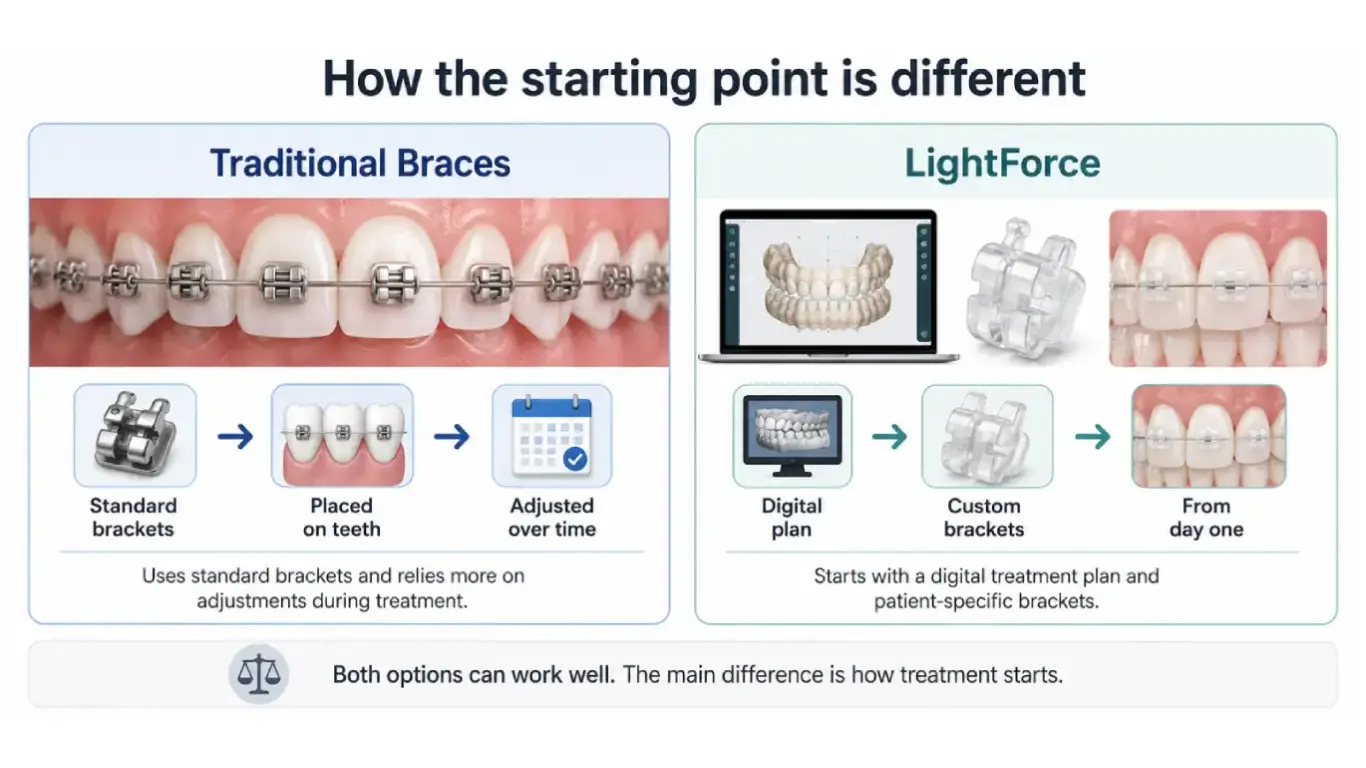
With traditional braces, the orthodontist uses standard brackets, places them on the teeth, and then adjusts treatment over time using wire changes, bracket repositioning, elastic instructions, and finishing bends.
That works. Traditional braces can create excellent results.
But LightForce changes the starting point.
Instead of using standard brackets and customizing mainly during treatment, LightForce uses a digital treatment plan to create patient-specific brackets from the beginning.
For the right patient, this may help with:
- more accurate bracket setup
- more personalized tooth movement planning
- fewer manual finishing steps in some cases
- fewer appointments in some cases
- shorter treatment time in some cases
- a fixed braces option that does not depend on aligner wear time
- a treatment experience that feels more planned from the start
This does not mean LightForce guarantees a better smile than regular braces. A skilled orthodontist can achieve excellent results with traditional metal braces, ceramic braces, Invisalign, or LightForce.
The better way to understand LightForce is this:
It may improve the process, not magically guarantee the result.
Is LightForce Cheaper Than Regular Braces?
Usually, no.
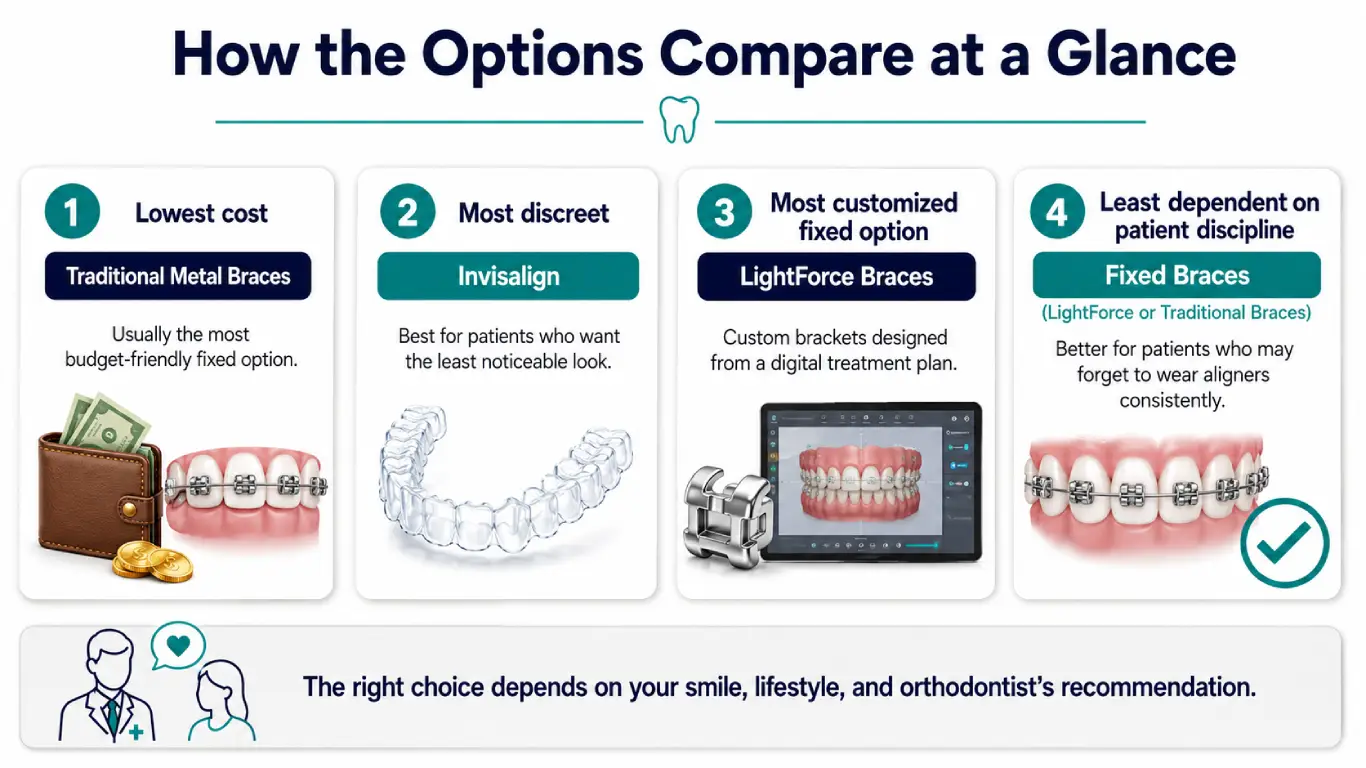
If your main priority is the lowest possible cost, traditional metal braces may be the better option.
LightForce may cost more because it involves digital planning, custom bracket design, 3D printing, and a more personalized appliance workflow.
So LightForce should not be presented as the “budget option.”
A better way to explain the cost is:
You are not paying extra just because the braces are new. You may be paying for a more customized process.
That may be worth it for some patients, but not for everyone.
Is LightForce More Comfortable?
LightForce may feel comfortable for some patients because the brackets are designed for the patient’s tooth anatomy. But it is still braces.
That means you can still expect some pressure after wire changes. You may still need time to adjust. You still need to brush carefully around brackets. You may still need to avoid hard or sticky foods.
So the honest answer is:
LightForce may offer a more customized fit, but it does not mean orthodontic treatment becomes completely pressure-free or effortless.
Is LightForce More Precise?
This is one of the stronger reasons an orthodontist may discuss LightForce.
LightForce is designed to make treatment more precise because the brackets are generated from the digital treatment plan. LightForce says each bracket is created with control over details such as base, slot, prescription, position, tie wings, and hooks.
In normal patient language, this means:
The bracket is not just placed and adjusted around a general plan. The bracket itself is part of the plan.
That can help the orthodontist start treatment with a more customized setup.
But precision still depends on the orthodontist.
The software does not replace clinical judgment. Your orthodontist still needs to diagnose your bite, plan your movements, monitor your progress, and make changes when needed.
Is LightForce Faster?
Possibly, in some cases.
But it should never be promised as “always faster.”
A 2024 article in the Journal of Clinical Orthodontics reported that patients treated with LightForce 3D-printed custom brackets had shorter treatment times and fewer appointments on average compared with conventional brackets in the practices studied. The study also reported fewer finishing procedures involving bracket repositioning or archwire-detailing bends in the LightForce group.
That sounds promising.
But it is important to be honest: the study was retrospective, not a randomized clinical trial. Even an orthodontic reviewer discussing the study pointed out that stronger evidence, such as randomized trials and more complete treatment-result measurements, would be needed before making overly strong claims.
So the fair answer is:
LightForce may help make treatment more efficient in some cases, but faster treatment is not guaranteed.
Treatment time still depends on:
- case complexity
- bite problems
- patient age
- oral hygiene
- broken brackets
- elastic wear if needed
- appointment consistency
- biological tooth movement
- orthodontist planning
Does LightForce Give Better Results?
Not automatically.
This is important for trust.
LightForce does not guarantee a better final smile than traditional braces.
Traditional braces can still produce excellent results. Invisalign can also produce excellent results for the right patient. LightForce is not about saying every other option is outdated.
The real difference is the workflow.
LightForce may help the orthodontist start with a more customized system. That may reduce some of the manual finishing work in certain cases. But the final result still depends on good diagnosis, good planning, good monitoring, and patient cooperation.
So if a patient asks:
“Will LightForce give me a better result?”
A better answer is:
“It may help us plan and deliver treatment more precisely, but the best result still depends on your case and how the treatment is managed.”
Why an Orthodontist May Recommend LightForce
An orthodontist may recommend LightForce orthodontics when a patient needs fixed braces but could benefit from a more customized digital approach.
This may happen when:
- the patient is not an ideal Invisalign candidate
- the patient may not wear aligners consistently
- the case needs the control of fixed braces
- the orthodontist wants a more digitally planned setup
- the family wants a modern braces option
- fewer appointments would be helpful for a busy schedule
- the patient wants something more personalized than standard metal braces
LightForce is not usually recommended just because it is “cool technology.”
It may be recommended because the orthodontist believes custom brackets and digital planning could improve the treatment experience for that specific patient.
That is the key:
LightForce should be case-based, not trend-based.
How LightForce Braces Work?
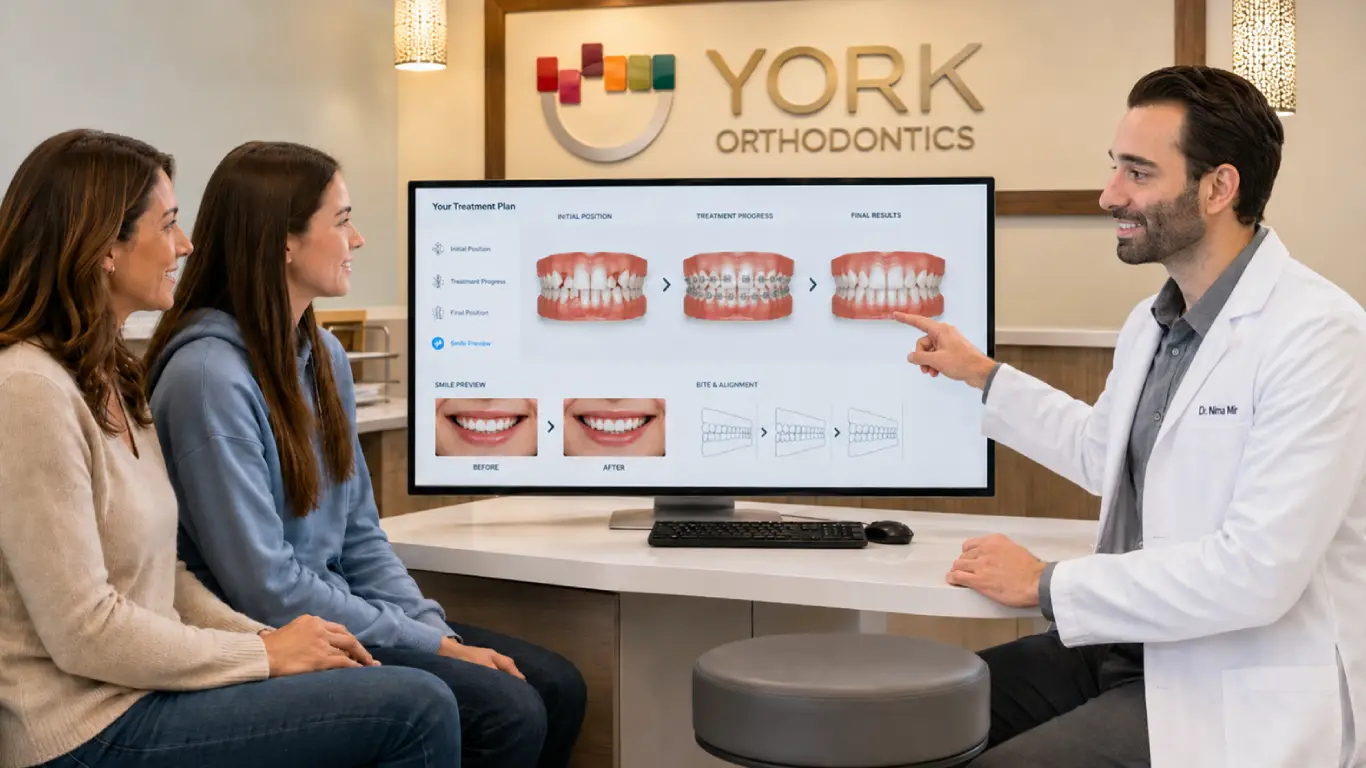
The LightForce treatment process is easier to understand when you think of it in five stages.
1. Consultation
The orthodontist examines your teeth, bite, jaw relationship, crowding, spacing, and smile goals.
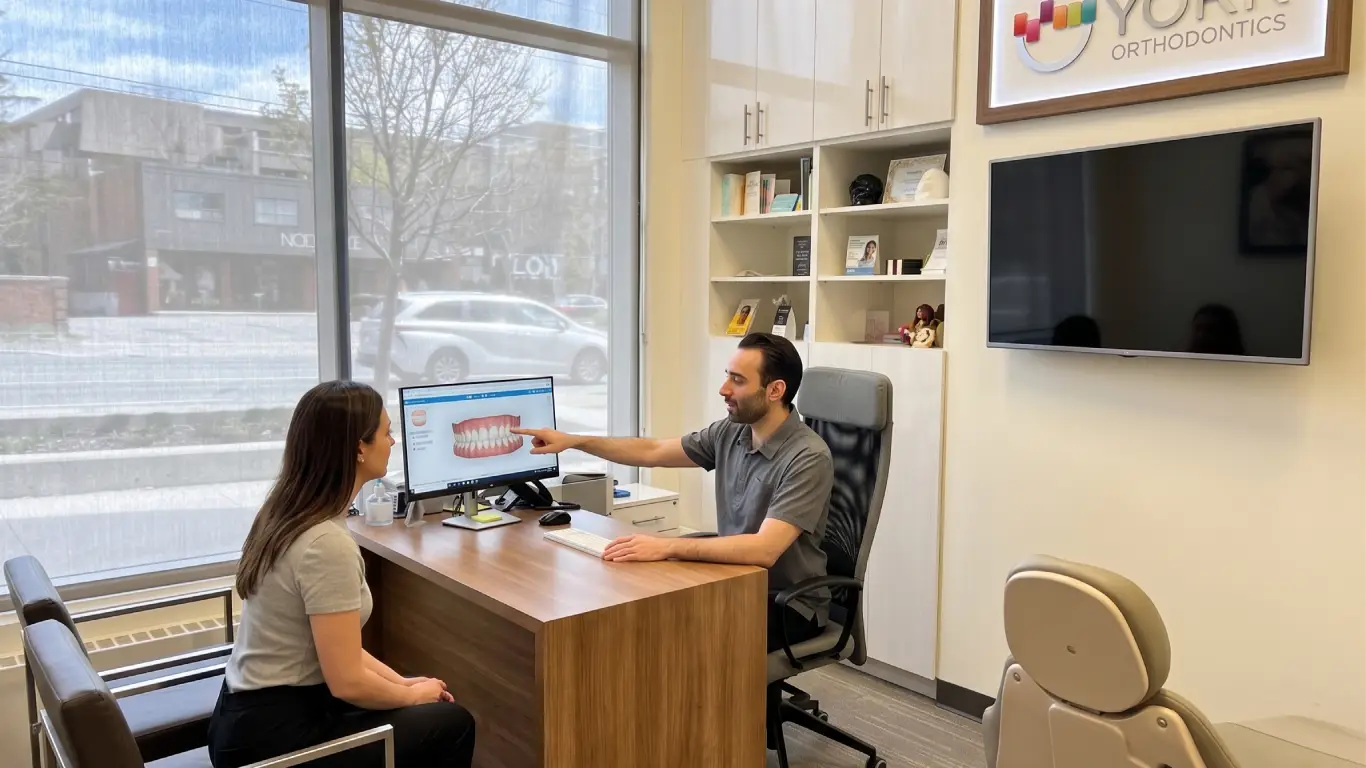
This is where the decision starts. Before choosing LightForce, Invisalign, or metal braces, the orthodontist needs to know what problem is being treated.
2. Digital Scan
A digital scan creates a 3D model of your teeth.
An iTero scanner, for example, captures high-resolution 3D images of the teeth and bite and can replace traditional impressions with a faster digital process.
3. Digital Treatment Plan
The orthodontist plans how the teeth should move.
This includes more than straightening front teeth. The plan may involve bite correction, rotations, spacing, crowding, arch shape, and final tooth positions.
4. Custom Bracket Design and 3D Printing
The LightForce bracket system is then created from the treatment plan.
LightForce describes its workflow as scan, plan, print, bond, and check. The brackets are 3D printed from the doctor’s digital treatment plan.
5. Placement and Monitoring
The brackets are placed on your teeth, and treatment begins.
You still need progress visits. Your orthodontist still monitors movement, changes wires, checks your bite, and makes adjustments when needed.
LightForce is not “set it and forget it.” It is still orthodontic treatment.
LightForce vs Traditional Braces: What Actually Changes?
Traditional braces and LightForce braces both use brackets and wires.
The difference is how treatment starts.
With traditional braces, the orthodontist uses standard brackets and customizes treatment through appointments, wire changes, bracket repositioning, and finishing details.
With LightForce braces, the orthodontist creates a digital plan first, and the brackets are custom-made for the patient’s teeth and intended movements.
Traditional Braces May Be Better If:
- you want a more budget-friendly option
- your case can be treated effectively with standard brackets
- you do not mind metal braces
- your main priority is reliability and cost
LightForce May Be Better If:
- you want fixed braces with more personalization
- you like the idea of digital treatment planning
- your orthodontist wants more customization from the start
- fewer visits may be valuable for your schedule
- Invisalign is not the right fit for you
So, the honest comparison is not:
LightForce is better.
The honest comparison is:
LightForce is more customized from the beginning.
LightForce vs Invisalign: Which One Fits Your Life?
The comparison between LightForce vs Invisalign is not only about teeth.
It is about responsibility.
Invisalign is removable. That is a big benefit for eating, brushing, and appearance. But it also means the patient has to wear the aligners consistently. The American Association of Orthodontists says clear aligners need to be worn 20 to 22 hours per day or as prescribed by the orthodontist for best results.
LightForce braces are fixed. They stay on the teeth.
That can be a benefit for patients who do not want to manage aligner wear time every day.
LightForce May Make More Sense If:
- your teen may forget to wear aligners
- aligners may get lost at school
- your case needs fixed braces
- you want a custom option but not removable trays
- you want treatment that does not depend on daily wear-time discipline
Invisalign May Make More Sense If:
- you want the most discreet option
- you are responsible with wear time
- you want to remove the appliance for meals
- you want easier brushing and flossing
- your case is suitable for aligners
So the question is not only:
“Which one looks better?”
The better question is:
“Which one can I realistically follow for the full treatment?”
What’s the Difference Between LightForce and Invisalign?
The simple difference is:
LightForce is custom fixed braces. Invisalign is removable clear aligners.
LightForce uses brackets and wires. Invisalign uses clear plastic trays.
LightForce may be a better fit if you need braces or prefer a fixed system. Invisalign may be better if appearance and removability are your top priorities and you can wear the aligners properly.
Neither option is automatically better.
A responsible Invisalign patient may do very well. A patient who forgets aligners may do better with fixed braces. A complex case may need braces. A mild case may do well with aligners.
That is why the orthodontic consultation matters.
LightForce Braces vs Metal Braces
When patients compare LightForce braces vs metal braces, they usually want to know:
“Is custom worth the extra cost?”
The answer depends on what you value.
Metal braces are strong, proven, and often more affordable.
LightForce braces may be more personalized, more digitally planned, and potentially more efficient in some cases.
If your case is simple and cost is your main concern, metal braces may be a great option.
If you want a custom fixed-braces system and your orthodontist believes it may help your treatment workflow, LightForce may be worth considering.
How Much Do LightForce Braces Cost Compared to Other Options?
LightForce braces cost can vary because every orthodontic case is different.
The cost may depend on:
- case complexity
- treatment length
- type of appliance
- digital scans and records
- custom bracket manufacturing
- number of visits
- Retainers
- insurance coverage
- payment plan options
- clinic location
LightForce is usually not positioned as the cheapest option. Traditional metal braces may be more budget-friendly.
So instead of only asking:
“How much do LightForce braces cost?”
Ask:
“What am I getting for the extra cost compared with regular braces?”
In many cases, what you are paying for is:
- digital planning
- custom bracket design
- 3D-printed brackets
- a more personalized setup
- potential treatment efficiency
- a fixed system that does not depend on aligner compliance
The best way to know the exact cost is to schedule an orthodontic consultation and compare LightForce, traditional braces, and Invisalign based on your own case.
Are LightForce Braces Worth the Investment?
They can be, but not for everyone.
LightForce may be worth it if you value a custom treatment workflow, digital planning, and fixed braces that are designed around your teeth from the beginning.
It may also be worth considering if you are not a good Invisalign candidate but still want something more personalized than standard braces.
But LightForce may not be worth the extra cost if your case is simple, your budget is tight, or traditional braces can achieve the same goal efficiently.
A good orthodontist should help you compare the value, not just the technology.
Who May Be a Good Candidate for LightForce?
LightForce may be a good option for:
- teens who may not manage Invisalign well
- adults who need fixed braces but want a modern option
- patients who want personalized braces
- patients with busy schedules who value fewer visits if possible
- patients interested in digital orthodontics technology
- patients whose case may benefit from custom bracket planning
Example: A Teen With Crowding
A parent likes Invisalign but worries their teen may forget the aligners at school or not wear them enough.
If the teen needs fixed braces, LightForce may be a strong option because it stays on the teeth while still offering a customized system.
Example: An Adult Who Wants Invisalign but Needs Braces
An adult may prefer Invisalign for appearance, but the orthodontist may recommend braces for better control.
In this case, LightForce can offer a more modern fixed-braces option.
Example: A Busy Family
A family in North York or Thornhill may care about appointment time and convenience.
If LightForce can reduce visits in their specific case, that may be valuable. But this should be discussed honestly during the consultation, not promised as a guarantee.
Who May Not Need LightForce?
LightForce may not be necessary if:
- your case is very simple
- traditional braces can treat your case well
- your main priority is the lowest cost
- you want the most invisible option
- you strongly prefer removable aligners
- your orthodontist recommends another treatment
This section matters because a patient should not feel pushed into LightForce just because it is newer.
The right treatment is not always the most advanced one.
The right treatment is the one that fits your case.
LightForce Orthodontics in North York, Thornhill, and Toronto
If you are searching for LightForce orthodontics North York, LightForce braces Toronto, or orthodontic treatment near Thornhill, you are probably looking for two things:
A modern treatment option and an orthodontist who can explain it clearly.
For local patients, convenience matters. Orthodontic treatment usually involves consultation, records, placement, progress checks, possible emergency visits, and retainers. Choosing a clinic close to home, school, or work can make the process easier.
When comparing orthodontic clinics, ask:
- Do you offer LightForce braces?
- Do you use digital scans?
- How do you compare LightForce with Invisalign and metal braces?
- Can you explain why you recommend one option over another?
- Do you show real before-and-after cases?
- Do you offer payment plans?
- What is included in the total cost?
- What is the retainer plan after treatment?
What LightForce Does Not Mean
This is worth saying clearly.
LightForce does not mean:
- cheapest braces
- invisible braces
- no appointments
- no adjustments
- no retainers
- guaranteed faster treatment
- guaranteed better results
- suitable for every patient
LightForce is a tool. A very advanced tool, but still a tool.
The result depends on the diagnosis, the treatment plan, the orthodontist’s experience, the patient’s cooperation, and retainer use after treatment.
Simple Decision Guide: Should You Ask About LightForce?
Ask about LightForce if you want:
- fixed braces
- a custom bracket system
- digital treatment planning
- a more personalized process
- an alternative to Invisalign
- a modern option beyond standard braces
You may prefer Invisalign if you want:
- removable aligners
- a more discreet look
- easier eating and brushing
- fewer food restrictions
- and you can wear aligners consistently
You may prefer traditional braces if you want:
- a reliable option
- a more budget-friendly treatment
- a simple fixed system
- a treatment that has worked well for many years
The best choice is not the one with the most advanced name.
The best choice is the one that works for your teeth and your daily life.
Final Thoughts
LightForce orthodontics is not just “3D-printed braces.”
It is a different way to plan and deliver fixed braces treatment.
The main benefit is that more of the orthodontist’s treatment plan can be built into the braces from the beginning. For the right patient, that may help make treatment more personalized, more efficient, and easier to manage.
But LightForce is not automatically cheaper, faster, more invisible, or better for everyone.
Traditional braces can still create excellent results. Invisalign can be a great choice for the right patient. LightForce simply gives patients another option, one that may be especially helpful when fixed braces are needed and customization matters.
If you are comparing LightForce braces, Invisalign, or traditional braces in North York, Thornhill, or Toronto, the next step is a proper orthodontic consultation.
At York Orthodontics, the goal is not to push one treatment for everyone. The goal is to understand your smile, explain your options clearly, and help you choose the treatment that makes the most sense for your case.
Book an orthodontic consultation to find out whether LightForce braces, Invisalign, metal braces, MRPE, another option is right for you.
FAQs
LightForce orthodontics is a digital braces system that uses custom 3D-printed brackets designed from the patient’s tooth anatomy and the orthodontist’s treatment plan.
No. LightForce should not be understood mainly as clear or invisible braces. The main difference is the custom digital workflow, not just appearance.
Usually, no. Traditional metal braces may be more budget-friendly. LightForce may cost more because it involves digital planning and custom 3D-printed brackets.
LightForce is designed to be more customized and digitally planned. The brackets are generated from the treatment plan, which may help create a more precise starting setup.
They may be faster in some cases, but it is not guaranteed. Some clinical reports show fewer visits and shorter treatment times, but results vary by case and provider.
Not automatically. Traditional braces, Invisalign, and LightForce can all create excellent results when planned and monitored properly.
An orthodontist may recommend LightForce when fixed braces are needed and a more customized digital bracket system may help the treatment workflow.
LightForce uses fixed custom brackets and wires. Invisalign uses removable clear aligners that must be worn consistently.
They may be a good option for teens who need braces but may not be responsible enough for removable aligners.
Yes, adults may be candidates if fixed braces are suitable and they want a more digitally planned option.
The process usually includes consultation, digital scan, digital treatment planning, custom bracket design, 3D printing, bracket placement, monitoring, and retainers.
LightForce custom brackets are brackets designed for the patient’s specific teeth and planned tooth movements instead of standard bracket shapes.
Many digital orthodontic workflows use intraoral scanners such as iTero. The exact scanner depends on the clinic.
If you are looking for LightForce orthodontics in North York, Thornhill, or Toronto, ask during your consultation whether LightForce is available and suitable for your case.