

3D Printed Clear Aligners: How Direct Printing Is Changing Orthodontics
Imagine two clear aligners sitting side by side. They may look nearly identical, but they could have been made in very different ways.
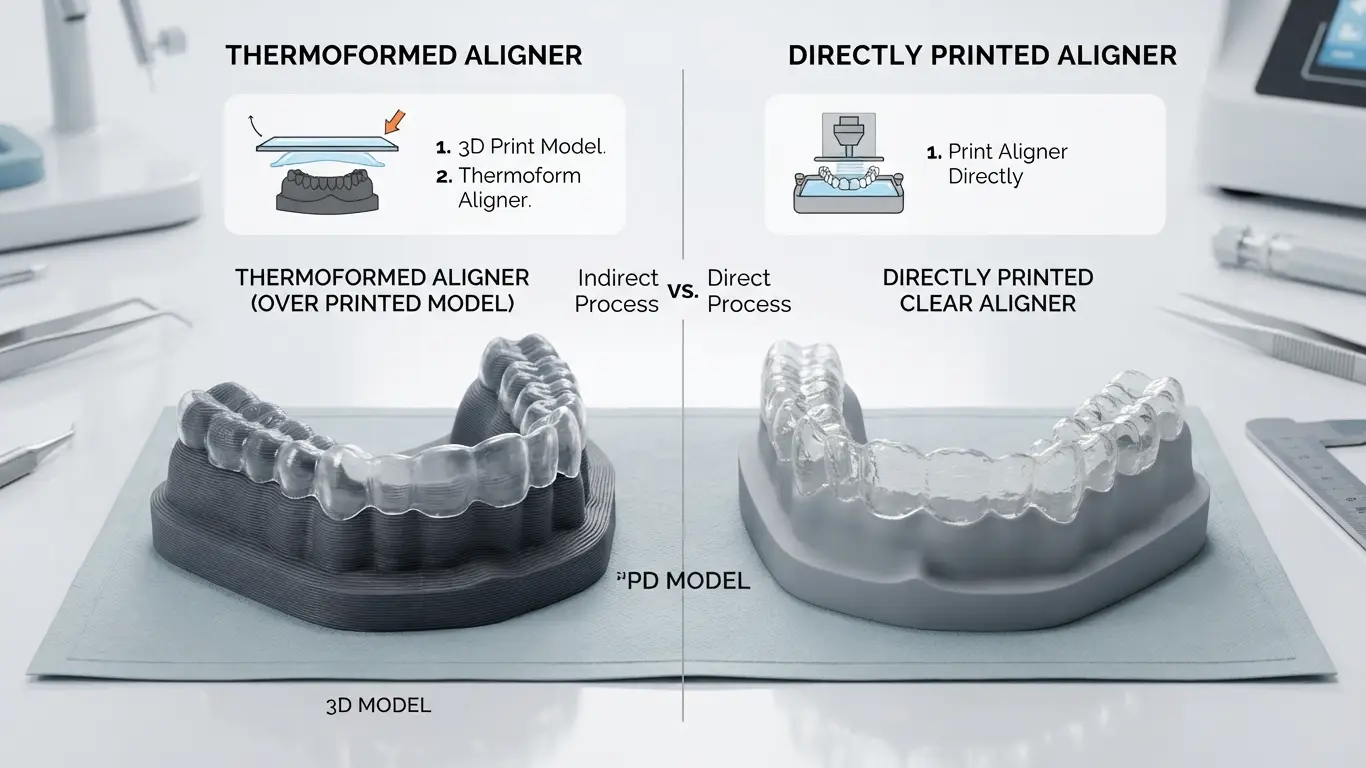
One may have been shaped over a separate 3D-printed model of your teeth. The other may have been printed directly from a digital treatment plan using a specialized clear aligner resin. That second appliance is known as 3D printed clear aligners, or direct-printed aligner.
The difference is not simply about using a newer machine. Direct printing may give orthodontic teams greater control over the aligner’s shape and thickness, but treatment success still depends on accurate diagnosis, careful planning, appropriate manufacturing, and consistent wear.
Quick Answer
A 3D printed clear aligner is produced directly from a digital orthodontic design using a biocompatible light-cured resin. This eliminates the separate model and thermoforming steps used in conventional aligner manufacturing. Direct printing may allow more control over aligner thickness and material properties, but research on its long-term clinical performance is still developing. Whether it is suitable for you requires an orthodontic examination, not simply a preference for newer technology.
What Is a 3D Printed Clear Aligners?
A 3D printed clear aligner is a removable orthodontic tray created layer by layer from a digital design.
Treatment generally begins with a scan of the teeth. The orthodontist diagnoses the bite and plans a series of small tooth movements using specialized software. A digital file is then created for every planned aligner.
In conventional production, manufacturers commonly:
Print a physical model of the teeth for each treatment stage.
Heat a plastic sheet.
Form the sheet over the model.
Trim and finish the aligner.
With direct printing, the physical model and heated plastic sheet are removed from the workflow. The aligner itself is printed from a photo-curable resin and then cleaned, post-cured, finished, inspected, and approved before use.
Patients who want a broader explanation of scanning, planning, materials, wear and treatment monitoring can explore York Orthodontics’ guide to clear aligner technology.
How Are Direct-Printed Aligners Made?
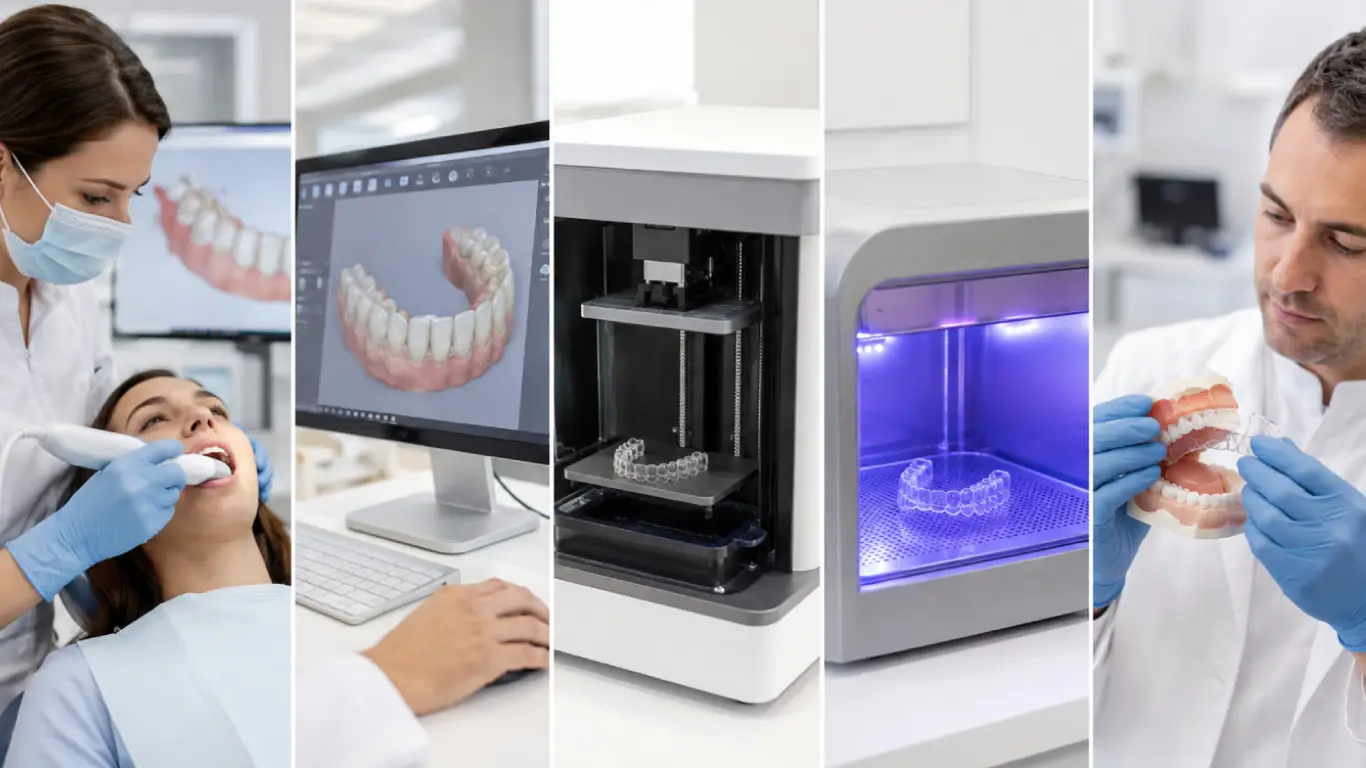
The exact workflow depends on the system, but it commonly includes the following stages:
1. Clinical examination and digital scan
The orthodontist examines the teeth, gums, jaws and bite. Photographs, X-rays and an intraoral scan may be required because the visible position of the crowns is only part of the diagnosis.
2. Digital treatment planning
Specialized software creates a virtual model and divides the planned movement into a sequence of stages. The orthodontist must review this plan because software alone cannot decide whether a movement is biologically appropriate or clinically predictable.
3. Direct printing
Each aligner is printed layer by layer using a compatible printer and a resin intended for intraoral orthodontic use. Different areas may potentially be designed with different thicknesses, depending on the material, software and validated production system.
4. Cleaning and post-curing
Printing is not the final step. Uncured material must be removed, and the appliance must be post-cured according to the manufacturer’s validated protocol.
This stage matters. Laboratory research indicates that the biocompatibility of printed aligners can be affected by resin selection and post-processing conditions. A 2025 study involving a Graphy material emphasized the importance of following the standardized production and UV-curing protocol precisely (Scientific Reports).
5. Finishing and clinical inspection
Supports and rough edges are removed where applicable. The clinician then evaluates the aligner’s surface, fit and design before delivering it to the patient.
What Are Graphy 3D Printed Aligners?
Graphy is a dental-material manufacturer associated with directly printed orthodontic aligners. Patients may encounter the phrases Graphy 3D printed aligners, Graphy direct printed aligners, or shape-memory aligners when researching this subject.
Graphy’s Tera Harz Clear materials are light-cured resins used to manufacture sequential orthodontic aligners. According to an FDA 510(k) summary for Tera Harz Clear, the system includes TC-85DAC, TR-07 and TA-28 models and is intended for professionally supervised treatment of malocclusion in patients with permanent dentition.
The FDA document also describes a complete manufacturing system involving compatible scanning, planning, printing and post-curing equipment. In other words, regulatory clearance does not mean that any printer, curing device or improvised workflow can safely produce the same appliance.
Some Graphy materials are described as having shape-memory behaviour. This refers to the material’s ability, under specified conditions, to move back toward its designed form after deformation. It should not be interpreted as proof that an aligner will move every tooth exactly as planned or that it is automatically better than other aligner systems.
York Orthodontics’ website does not currently confirm that the clinic provides Graphy aligners specifically. Patients interested in this brand should ask the team which clear-aligner systems are presently available and why a particular system may be recommended.
What Is Clear Aligner Resin?
Clear aligner resin is a photo-reactive liquid material formulated to become a solid orthodontic appliance when exposed to a controlled wavelength of light.
This material must provide an appropriate combination of:
- Biocompatibility for its intended oral use
- Transparency
- Flexibility and strength
- Dimensional stability
- Resistance to the warm, moist oral environment
- Sufficient force delivery for planned tooth movement
- Compatibility with the complete printing and curing workflow
Not every transparent 3D-printing resin is suitable for use in the mouth. Patients should never purchase an unverified printed appliance or attempt to produce an aligner using a consumer printer. Material selection, printer calibration, cleaning, post-curing and professional inspection all affect the final appliance.
A scientific review of direct aligner printing noted its potential to control characteristics such as thickness while also identifying the need for further research on materials and clinical performance (Progress in Orthodontics review).
Read More: LightForce Braces
What Are the Potential Benefits of Direct Printing?
Direct printing offers promising manufacturing and design possibilities, although not every theoretical advantage has been confirmed through large, long-term clinical studies.
Potential benefits include:
- Fewer production steps: Direct printing removes the need to print a separate dental model and form plastic over it.
- Thickness customization: Some workflows may allow selected areas of the aligner to be designed with different thicknesses.
- Reduced material use: Eliminating disposable models and thermoforming sheets may reduce manufacturing waste.
- Digital flexibility: A new stage or revised appliance may be designed digitally when clinically appropriate.
- Potential in-office production: Compatible equipment may allow qualified practices or laboratories to manage more of the workflow locally.
- Material behaviour: Certain resins are designed to offer properties that differ from conventional thermoformed plastic.
These benefits concern how the appliance is designed and made. They do not remove the need for diagnosis, attachments when required, enamel reduction in selected cases, monitoring, refinements or patient cooperation.
What Are the Limitations?
Patients should also understand what remains uncertain.
Clinical evidence is still developing
A 2024 clinical study found that directly printed aligners were effective for the mildly misaligned cases evaluated, but the authors also called for additional evidence involving more complex movements and broader patient groups (Progress in Orthodontics clinical study).
Manufacturing is technique-sensitive
An error in printing, cleaning, post-curing or finishing can affect the appliance. A sophisticated material only performs as intended when the validated workflow is followed.
Direct printing does not make every case suitable for aligners
Severe bite discrepancies, substantial rotations, significant skeletal concerns or movements requiring stronger control may need attachments, auxiliaries, braces or a combined approach.
Aligners still depend on patient cooperation
A removable appliance cannot work while sitting in its case. Patients must wear each tray according to their orthodontist’s instructions and attend monitoring appointments.
Availability varies
Not every orthodontic practice uses direct-print systems, and practices that do may use different materials or workflows. Patients should confirm what is offered instead of assuming every “3D” aligner is directly printed.
Read More: What Is Indirect Bonding In Orthodontics
3D Printed Braces vs Metal Braces: What Is the Difference?
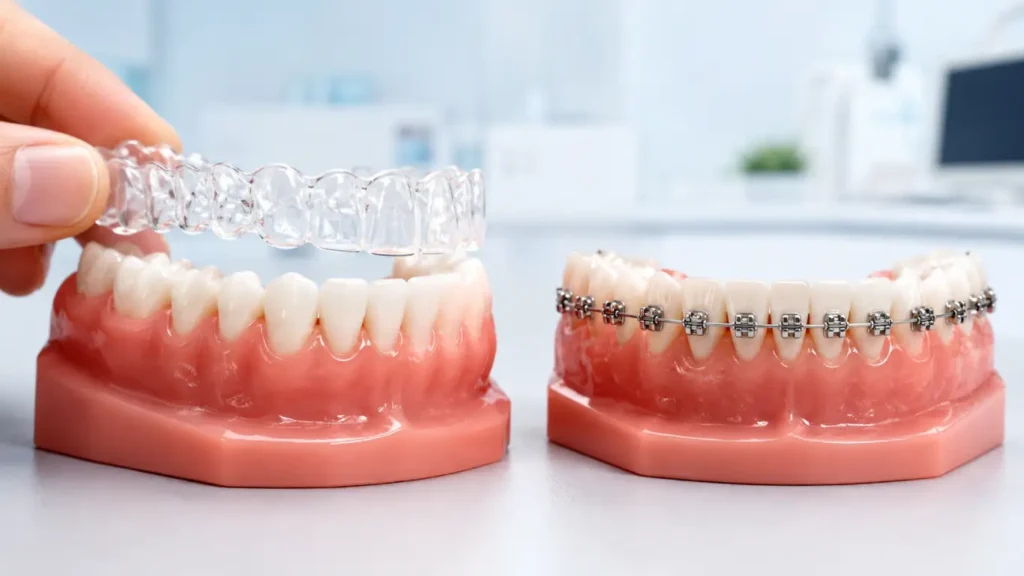
The phrase “3D printed braces” can cause confusion. A direct-printed clear aligner is not technically a set of braces. It is a removable tray. Metal braces use fixed brackets and archwires.
Some brackets, such as LightForce custom ceramic brackets, can also be 3D printed, but they belong to a different treatment category.
| Factor | Direct-printed clear aligners | Metal braces |
|---|---|---|
| Appliance | Removable transparent trays | Fixed brackets and wires |
| Visibility | Generally discreet | More noticeable |
| Eating | Removed for meals | Certain foods may need to be avoided |
| Cleaning | Removed for brushing and flossing | Cleaning around brackets requires more care |
| Patient responsibility | Consistent wear is essential | Appliance works continuously because it is fixed |
| Case selection | Suitable for selected cases | Can provide strong control in many complex cases |
| Manufacturing | Printed from specialized resin | Uses manufactured brackets and orthodontic wires |
Neither treatment is universally superior. Patients comparing Invisalign aligners and braces should focus on diagnosis, treatment control, daily habits and long-term stability, not manufacturing novelty alone.
How Much Do 3D-Printed Braces or Aligners Cost?
There is no reliable universal fee for a directly printed aligner treatment in Canada.
Patients searching for “3D-printed braces cost” are usually looking for either direct-printed aligner fees or custom 3D-printed bracket fees. These are different treatments, so they should not be grouped under one price.
The total orthodontic fee may depend on:
- The type and complexity of the bite problem
- The number of planned aligners
- Whether refinements are needed
- Diagnostic records and treatment planning
- Attachments or additional appliances
- The manufacturing system
- The length and level of clinical monitoring
- Retainers and what the quoted fee includes
- Insurance coverage and financing arrangements
Direct printing may reduce some laboratory steps, but lower manufacturing costs do not automatically translate into a lower patient fee. The largest part of orthodontic care is not simply the piece of material: it includes diagnosis, planning, supervision, adjustments and retention.
York Orthodontics explains that the cost of braces depends on the selected appliance, case complexity, treatment length and any additional devices required. A personalized consultation is therefore more useful than comparing isolated online prices.
How Do You Know Whether This Technology Is Right for You?
The best aligner is not necessarily the one with the newest manufacturing label. It is the appliance that allows your orthodontist to carry out an appropriate treatment plan safely and predictably.
Before choosing, ask:
- Is my bite suitable for clear-aligner treatment?
- What movements will be difficult to achieve?
- Will I need attachments or other auxiliaries?
- Who designs and approves the treatment plan?
- Is the aligner directly printed or formed over a printed model?
- Which resin and validated post-curing system are used?
- How will my progress be monitored?
- What happens if my teeth do not track as planned?
- Are refinements and retainers included in the fee?
- Would fixed braces offer better control for my case?
At York Orthodontics, clear-aligner care may begin with a digital scan and personalized assessment. The clinic also provides both clear aligner treatment and fixed braces options, allowing the recommendation to be based on the patient’s bite and practical needs rather than one technology alone.
Read More: LightForce vs Invisalign
The Takeaway
A 3D printed clear aligner is produced directly from a digital file using a specialized light-cured resin. The approach may offer useful control over design, thickness and manufacturing, but it is not automatically faster, safer, cheaper or more effective for every patient.
Material quality and post-curing matter. So do diagnosis, treatment planning, case selection, consistent wear and professional monitoring. Current research is promising, particularly for selected mild cases, but evidence continues to evolve.
If you are comparing direct-printed aligners, conventional clear aligners and braces, contact York Orthodontics for an individualized assessment. The team can examine your teeth and bite, explain the options available at the clinic, and help determine which treatment method provides the right level of control for your needs.
FAQs
They can be appropriate when they are made from a material intended for intraoral use and produced with a validated printing, cleaning and post-curing workflow. Safety should not be assumed based only on the phrase “dental resin”; the complete manufacturing protocol and professional supervision matter.
There is not enough evidence to declare one universally better. Graphy and Invisalign involve different materials, manufacturing systems and treatment workflows. The better option depends on your diagnosis, required tooth movements, available clinical system and your orthodontist’s experience.
Direct printing may shorten the manufacturing workflow, but that does not necessarily shorten biological tooth movement or total treatment time. Treatment duration depends on the bite, movement complexity, response of the teeth, wear consistency and need for refinements.
They may be used in selected cases, but direct printing does not eliminate the clinical limitations of removable aligner therapy. Complex movements may require attachments, elastics, additional appliances, braces or another coordinated treatment approach.
Not necessarily. Direct printing may reduce certain manufacturing steps, but the patient’s total fee also includes diagnosis, planning, monitoring, refinements and retention. A written, personalized estimate is the only meaningful comparison.
No. Direct-printed aligners are removable trays, while braces are fixed appliances using brackets and wires. Some custom brackets can also be 3D printed, but they represent a separate treatment system.