

What Is Indirect Bonding In Orthodontics?
Indirect bonding is a way of placing braces on teeth by first positioning the brackets outside the mouth on a model or digital scan, then transferring them onto your teeth using a custom tray.
This technique aims to give more precise bracket placement compared with placing each bracket one by one directly on the teeth; it can also reduce chair time and improve patient comfort during the bonding appointment.
At York Orthodontics, understanding what indirect bonding is helps you see how it fits into modern options such as custom braces systems, including KLOwen Indirect Bonding, for patients in Thornhill, North York, and the surrounding GTA.
Indirect bonding in orthodontics starts with detailed planning. Instead of placing brackets directly on your teeth, the orthodontic team plans bracket positions on a model of your teeth or on a digital 3D scan.
A typical indirect bonding workflow looks like this:
An impression or digital scan of your teeth is taken so the orthodontist can see the exact shape and alignment.
Brackets are positioned on the model or in orthodontic software at carefully chosen angles and heights, using a precise bracket placement technique.
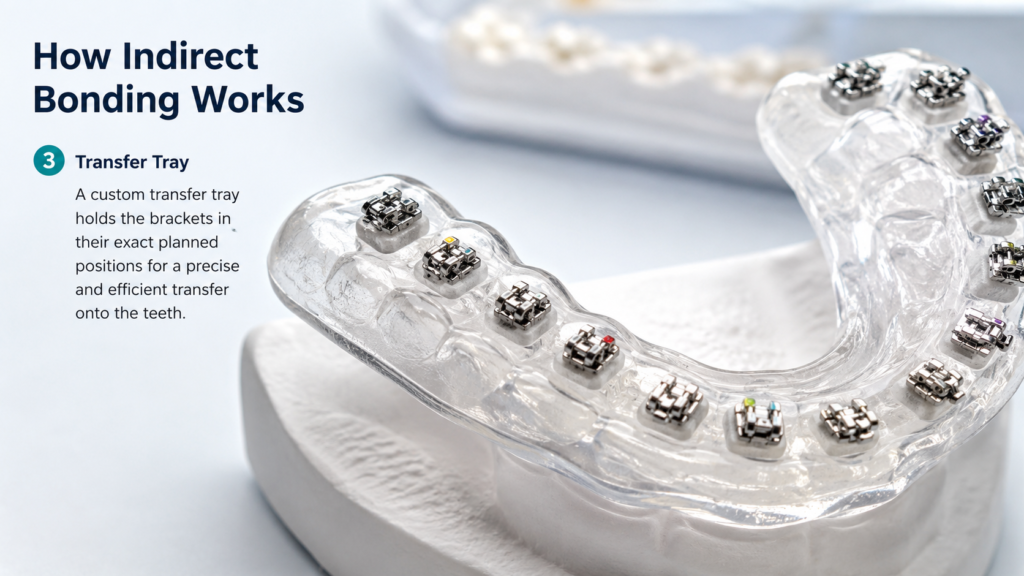
A custom transfer tray is made that “captures” the brackets in their planned positions.
At your bonding appointment, the tray with brackets is placed onto your teeth, adhesive is activated, and the tray is removed, leaving all brackets bonded in one carefully planned step.
This process allows the orthodontist to focus on accuracy during planning, not while you are sitting with your mouth open for a long time.
Indirect Bonding Definition In Orthodontics
From a clinical point of view, an indirect bonding definition in orthodontics is: a method where brackets are bonded to a model or virtually planned outside the mouth, then transferred to the teeth by a custom tray.
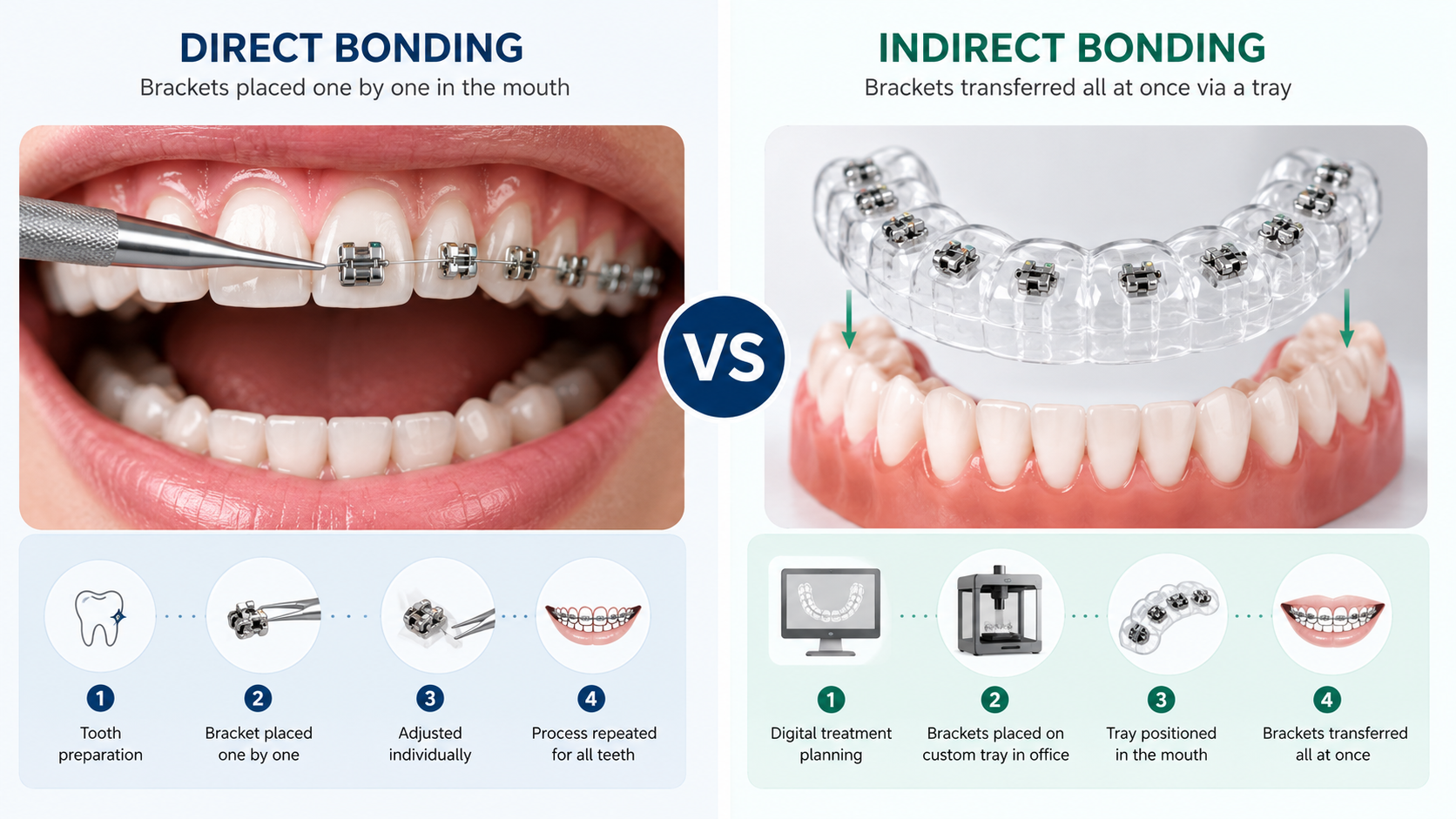
It is considered an alternative to conventional direct bonding, where each bracket is placed and adjusted individually on the tooth surface in the mouth.
With indirect bonding, the adhesive layer and bracket position can be standardized more easily, which may help with consistent forces on each tooth once wires are placed.
Indirect Bonding vs Direct Bonding
Many patients ask about indirect bonding vs direct bonding because both methods are used to place braces.
Here is a simple comparison:
| Aspect | Direct Bonding | Indirect Bonding |
|---|---|---|
| Where brackets are positioned | Directly on teeth during the appointment | On a model or digital plan, then transferred |
| Time in the chair | Often longer, each bracket placed individually | Often reduced chair time with indirect bonding |
| Planning environment | In the mouth, with saliva and limited visibility | Outside the mouth with full view and magnification |
| Precision of placement | Depends on in-mouth adjustments and clinician skill | Designed to improve precise bracket placement technique |
| Patient comfort during bonding | Mouth open longer, more individual adjustments | Potentially more comfortable, fewer minutes of fiddling |
Evidence from clinical studies suggests that indirect bonding can improve the accuracy of bracket placement compared with direct bonding, although outcomes still depend on the technique and materials used
Advantages Of Indirect Bonding
Indirect bonding offers several potential advantages of indirect bonding for both patients and orthodontists; these benefits are general and can vary by case.
Commonly reported advantages include:
More precise bracket placement, which may support better alignment and reduce the need for later repositioning.
Reduced chair time with indirect bonding, because multiple brackets are placed at once rather than one by one.
Improved patient comfort indirect bonding, since the bonding visit may feel shorter and involve fewer on-the-spot adjustments.
Standardized adhesive thickness under brackets, which can contribute to controlled tooth movement.
However, indirect bonding also involves laboratory or digital planning time before your appointment and relies on careful tray fabrication and transfer.
When Indirect Bonding Might Not Be The Right Choice
Even with clear advantages, indirect bonding is not automatically better for every case or every orthodontic practice.
Situations where direct bonding may still be used include:
Very simple cases where the orthodontist prefers to place each bracket directly.
Cases where specific teeth need adjustments that are easier to judge chairside.
Situations where lab access or digital planning tools are limited.
Clinical research comparing indirect bonding vs direct bonding shows that failure rates and clinical outcomes can be similar across techniques, so the choice often depends on the orthodontist’s training, workflow, and the tools available.
This is why a consultation at a practice such as York Orthodontics gives you a clearer sense of which bonding approach fits your treatment plan.
How KLOwen Indirect Bonding Fits Into Modern Custom Braces
KLOwen Indirect Bonding builds on the same principles but pairs them with custom braces design and digital workflows.
In the KLOwen system:
Bracket prescriptions are customized to the shape and treatment goals of each tooth, using advanced software.
Digital indirect bonding trays hold these custom brackets in ideal positions for transfer to your teeth.
The goal is to combine precise bracket placement with a personalized bracket design, which may reduce the need for wire bending and later bracket repositioning.
For a deeper explanation of how indirect bonding works with KLOwen custom braces in this specific practice, you can read York Orthodontics’ main guide on indirect bonding and KLOwen custom braces, which explains how digital planning and custom trays fit into their overall treatment philosophy.
What To Ask Your Orthodontist About Indirect Bonding
If you are thinking about braces and have heard of indirect bonding, a few practical questions can help during your consultation:
Will my case be better served by indirect bonding, direct bonding, or a mix of both?
How does your office plan bracket positions before the bonding appointment?
Do you use custom systems such as KLOwen or LightForce, and how do they interact with indirect bonding?
How might indirect bonding affect the length of my bonding visit and my comfort during the procedure?
These questions help you understand not just what indirect bonding is, but how it could affect your experience and your long-term treatment plan at a practice like York Orthodontics in Thornhill or North York.
FAQs
Many patients find indirect bonding more comfortable because the bonding visit can be shorter and involves fewer individual bracket adjustments; comfort still depends on personal sensitivity and the specifics of the case.
Indirect bonding can streamline the start of treatment by placing brackets efficiently and accurately; however, total treatment time depends on many factors such as case complexity, growth, and how well you follow instructions.
Indirect bonding can be used with labial metal braces, ceramic braces, and some custom systems, and it is also considered important in lingual orthodontics; your orthodontist will decide if it fits your specific appliance choice.
When done correctly, indirect bonding is widely used and considered safe; potential issues include bracket loss during transfer or adhesive flash, but careful tray design and technique reduce these risks.
The decision is usually made after a full orthodontic evaluation; the team considers your bite, tooth positions, and treatment goals, then chooses the bonding method that best supports your overall plan.