

Airway Orthodontics: Understanding the Connection Between Breathing, Sleep and Jaw Development
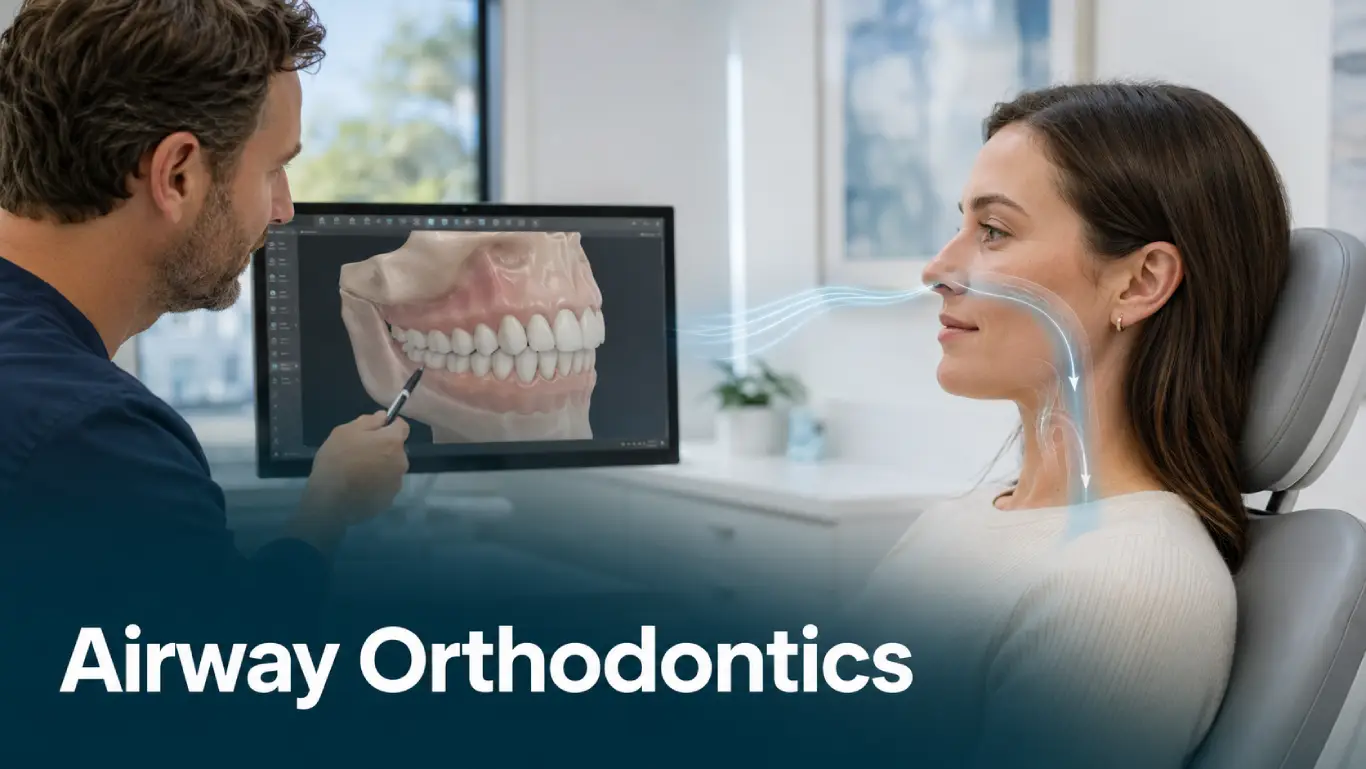
Airway orthodontics considers how the teeth, jaws, tongue and surrounding facial structures may relate to breathing and sleep. It does not mean that every breathing concern can be corrected with an orthodontic appliance, or that an orthodontist can diagnose sleep apnea from the appearance of the jaws alone.
A careful airway-focused assessment looks for relevant orthodontic findings, asks about possible sleep-disordered breathing symptoms and, when necessary, refers the patient to a physician or sleep specialist for diagnosis. Treatment should then address the patient’s confirmed medical and orthodontic needs rather than rely on a one-size-fits-all “airway” solution.
Quick Answer
Airway orthodontics is an orthodontic approach that considers breathing and sleep alongside tooth position, bite and jaw development. An airway orthodontist may recognize risk indicators and contribute to multidisciplinary treatment, but obstructive sleep apnea is a medical condition that requires appropriate medical evaluation. Palatal expansion, MARPE, mandibular advancement devices or orthognathic surgery may help selected patients when there is a clear diagnosis and treatment indication. Changes seen on an airway scan alone do not prove that breathing or sleep apnea has improved.
What Is Airway Orthodontics?
Airway orthodontics evaluates the relationship between the upper and lower jaws, dental arches, tongue space, bite and upper airway. The objective is not simply to make an airway look larger on an X-ray. It is to determine whether a patient has an orthodontic problem that may be relevant to breathing and whether collaboration with other healthcare professionals is needed.
An airway-focused orthodontic examination may include:
- A detailed medical, dental and sleep history
- Evaluation of the bite and jaw relationships
- Assessment of dental-arch width and crowding
- Observation of resting lip and tongue posture
- Questions about snoring, mouth breathing and sleep quality
- Referral for medical or sleep assessment when symptoms suggest a breathing disorder
The 2026 American Association of Orthodontists white paper on sleep-disordered breathing and orthodontics emphasizes an important boundary: orthodontists can screen for risk and participate in coordinated care, but they should not diagnose sleep-disordered breathing from craniofacial features, questionnaires or orthodontic imaging alone.
What Is the Role of an Airway Orthodontist?
An airway orthodontist is an orthodontist who gives particular attention to breathing-related symptoms and the possible contribution of craniofacial structure. The term does not represent a separate medical diagnosis or guarantee that airway treatment will be required.
The orthodontist’s appropriate role may include:
- Identifying orthodontic findings such as a narrow upper jaw, crossbite or significant jaw discrepancy.
- Asking about snoring, mouth breathing, pauses in breathing, restless sleep or daytime symptoms.
- Referring the patient to a family physician, pediatrician, otolaryngologist or sleep specialist.
- Coordinating orthodontic treatment with the patient’s broader medical care.
- Monitoring the bite, jaw joints and dental effects of appropriate oral appliances.
Sleep apnea should not be diagnosed from a cone-beam computed tomography scan. A static image shows anatomy at one moment while the patient is awake; it does not measure airflow, repeated airway collapse, oxygen levels or sleep quality. The AAO white paper also cautions that a larger airway measurement after treatment does not, by itself, demonstrate successful sleep-apnea treatment.
How Are Sleep Apnea and Orthodontics Connected?
Sleep-disordered breathing includes a spectrum of conditions ranging from habitual snoring to obstructive sleep apnea, or OSA. In OSA, the upper airway repeatedly narrows or closes during sleep.
Craniofacial features can be one part of a much more complicated condition. Tonsil and adenoid size, nasal obstruction, weight, age, neuromuscular control, sleep stage and other medical factors may also contribute. Therefore, the presence of a narrow palate, small lower jaw or overbite does not automatically mean a patient has sleep apnea.
Likewise, there is no evidence that routine orthodontic treatment can prevent sleep-disordered breathing throughout a person’s life. The decision to provide orthodontic treatment should be based on a genuine orthodontic indication, not an unsupported promise to prevent future OSA.
What Are the Signs of Pediatric Sleep-Disordered Breathing?
Possible signs in children include:
- Frequent snoring
- Mouth breathing during sleep
- Pauses, gasping or choking sounds
- Restless sleep or unusual sleeping positions
- Bedwetting beyond the expected age
- Morning headaches
- Difficulty concentrating
- Irritability, hyperactivity or daytime sleepiness
These signs do not confirm pediatric sleep-disordered breathing. The American Academy of Pediatrics recommends medical evaluation and, when indicated, polysomnography—a monitored sleep study—for children who snore regularly and have other symptoms of OSA.
An orthodontist may notice a narrow upper jaw, crossbite, crowding or altered oral posture during an examination. However, these observations should prompt appropriate investigation rather than an immediate sleep-apnea diagnosis.
How Does Airway Orthodontics for Children Work?
Airway orthodontics for children begins by separating two questions:
- Does the child have an orthodontic or jaw-development problem?
- Does the child have a medically diagnosed breathing or sleep disorder?
When both are present, orthodontic care may form one part of a multidisciplinary plan. For example, a growing child with a narrow upper jaw and crossbite may have a valid orthodontic reason for expansion. If the same child has confirmed sleep-disordered breathing, the medical and orthodontic teams can coordinate treatment and assess outcomes properly.
York Orthodontics provides early orthodontic treatment for selected children when growth guidance, space creation or bite correction is clinically appropriate. Not every child with snoring or mouth breathing needs early orthodontic treatment.
Palatal Expansion
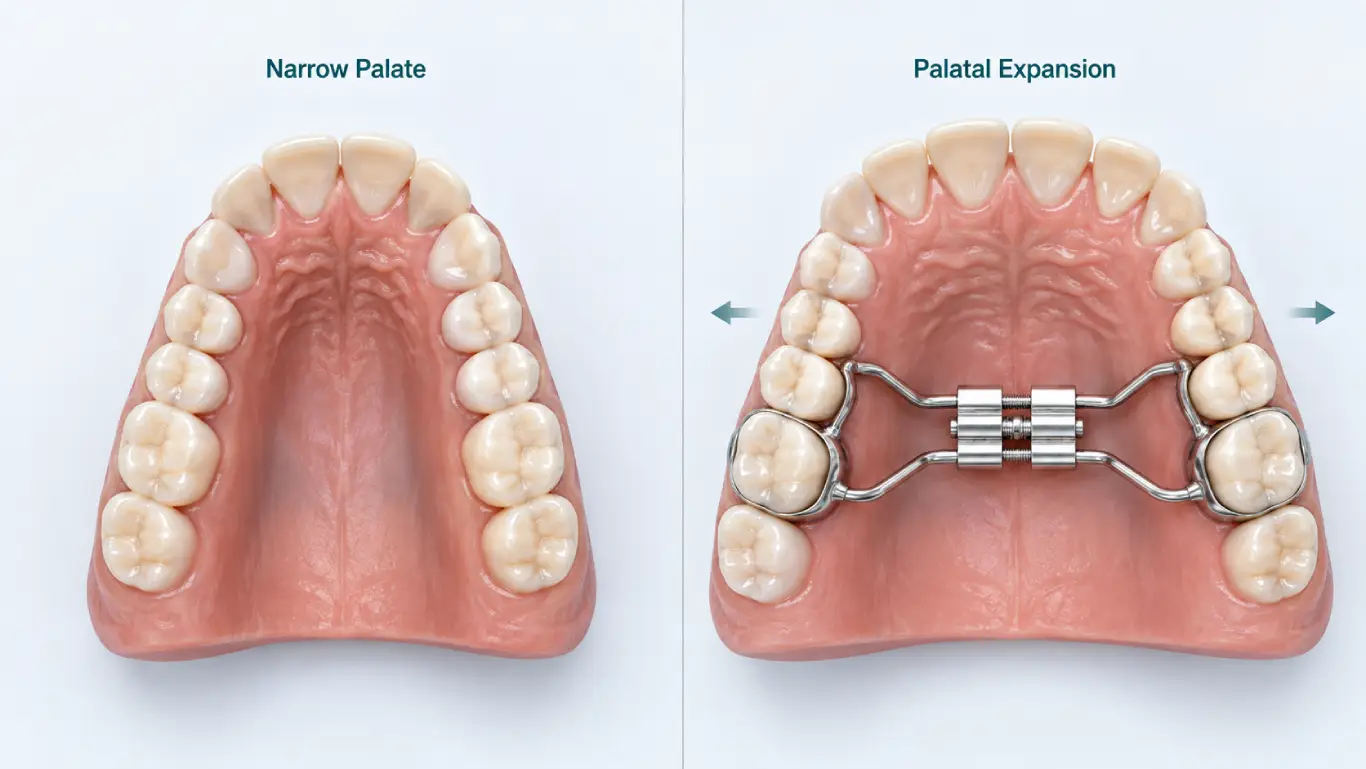
Palatal expansion widens a constricted upper jaw. It is commonly considered in growing patients with problems such as:
- Posterior crossbite
- A narrow maxillary arch
- Insufficient room for developing teeth
- Certain jaw-width discrepancies
Some studies report changes in nasal dimensions or breathing measures after expansion, but the evidence does not support using rapid maxillary expansion as a universal or preventive sleep-apnea treatment. According to the 2026 AAO white paper, expansion for pediatric sleep-disordered breathing should be reserved for patients who have both a confirmed breathing disorder and a clear orthodontic indication.
Parents can review how a palatal expander is fitted, activated and maintained during orthodontic treatment.
Habit Appliances
Habit appliances may help selected children stop persistent thumb-sucking, finger-sucking or tongue-related habits that affect tooth position or jaw development. They are not sleep-apnea appliances.
Before recommending an appliance, the orthodontist should identify why the habit persists and consider the child’s age, readiness and emotional response. An appliance that addresses a dental habit should not be marketed as a treatment for an undiagnosed airway condition.
Myofunctional Therapy
Myofunctional therapy uses structured exercises to improve tongue posture, lip function, nasal-breathing habits and orofacial muscle coordination. It may be provided by a properly trained professional as an adjunct to other care.
Research suggests potential benefits for selected sleep-disordered breathing patients, but protocols and evidence quality vary. It should not replace necessary evaluation by an ENT physician, sleep physician or other medical provider, and it should not be presented as a guaranteed cure for OSA.
Can Mouth Breathing Be Treated Orthodontically?
Mouth breathing treatment depends on its cause. A patient may breathe through the mouth because of nasal congestion, allergies, enlarged tonsils or adenoids, structural nasal obstruction, learned posture or several overlapping factors.
Orthodontic treatment cannot remove enlarged tonsils, control allergies or independently resolve every nasal obstruction. When persistent mouth breathing is reported, the correct approach may include:
- Medical or ENT evaluation
- Assessment for allergies or nasal obstruction
- Evaluation of the bite and jaw width
- Myofunctional therapy when appropriately indicated
- Orthodontic treatment for a confirmed dental or skeletal problem
The goal is to investigate the cause rather than assume that a narrow palate explains every case.
What Is Adult Airway Orthodontics?
Adult airway orthodontics follows the same evidence-based principles, but growth is largely complete. Treatment decisions must account for mature bone, periodontal health, missing teeth, previous orthodontic treatment and existing jaw-joint symptoms.
Options may include conventional orthodontics, MARPE for selected transverse deficiencies, a physician-prescribed mandibular advancement device or combined orthodontic-surgical care. York Orthodontics offers individualized adult orthodontic treatment based on the patient’s bite, dental condition and treatment goals.
MARPE
MARPE stands for miniscrew-assisted rapid palatal expansion. It uses temporary anchorage devices in the palate to direct more expansion force toward the upper-jaw bones and less solely through the teeth.
MARPE may be considered for some older adolescents and adults with a narrow upper jaw. Candidacy depends on anatomy, skeletal maturity, periodontal condition and the amount of correction required. Possible limitations include discomfort, appliance-cleaning challenges, gum or dental effects, miniscrew instability and incomplete skeletal expansion.
Although MARPE can change maxillary and nasal dimensions, that does not mean it will cure sleep apnea. Objective sleep outcomes, not scan volume alone, are needed to evaluate any effect on diagnosed OSA. Patients considering this option can review York Orthodontics’ guide to the MARPE appliance.
Mandibular Advancement Devices
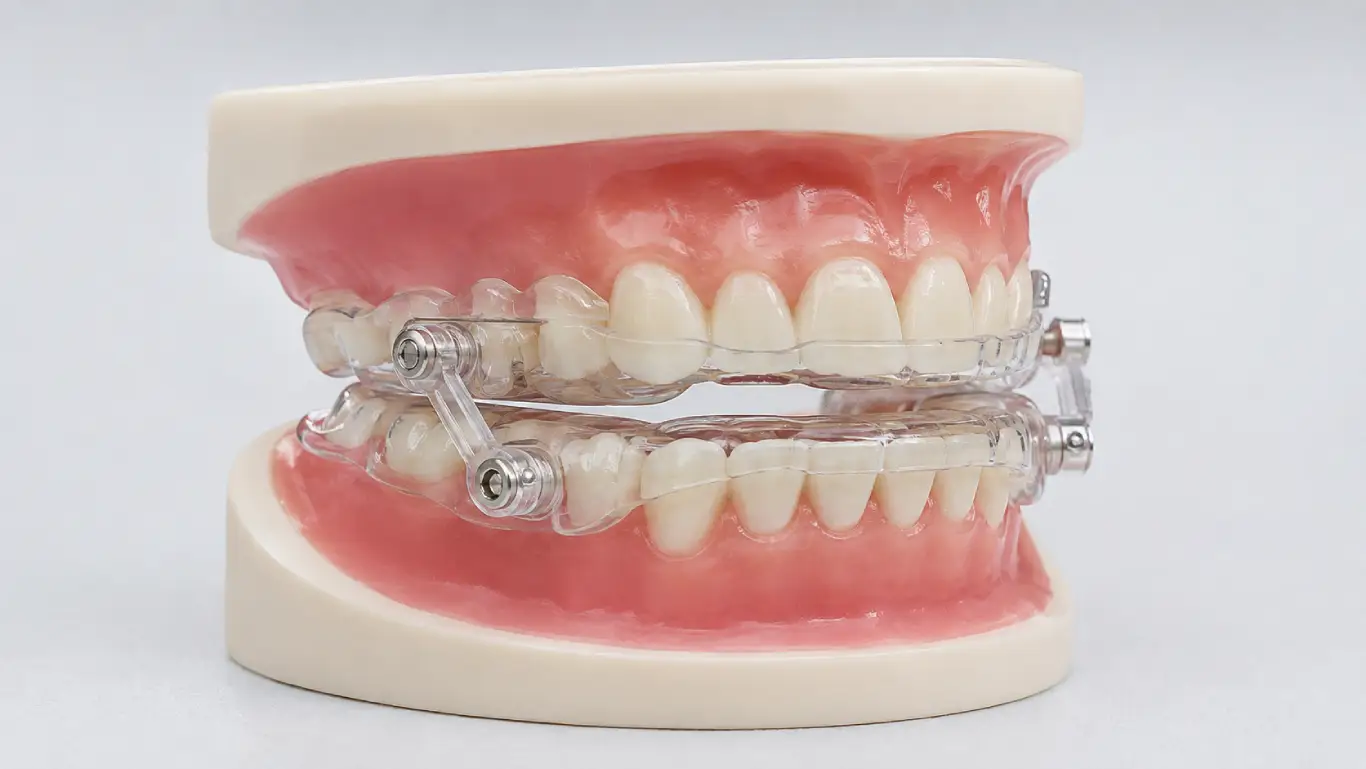
A mandibular advancement device is worn during sleep to hold the lower jaw forward and help maintain upper-airway space. It is different from a growth-modification appliance used in children.
The joint guideline from the American Academy of Sleep Medicine and American Academy of Dental Sleep Medicine recommends that sleep physicians consider prescription oral appliances for adults with OSA who cannot tolerate CPAP or prefer an appropriate alternative. A qualified dental professional should oversee the appliance, while the sleep physician confirms treatment effectiveness.
Potential effects include tooth movement, bite changes, muscle tenderness and TMJ discomfort. Long-term dental and sleep follow-up is therefore important.
Is There a TMJ and Airway Connection?
Temporomandibular disorders and sleep-disordered breathing can occur in the same patient, but their relationship is not simple. Current research shows an association in some populations, but it does not prove that TMJ problems cause sleep apnea or that airway treatment will automatically resolve jaw-joint pain.
This distinction matters when mandibular advancement devices are considered. Patients with existing jaw pain, restricted movement, joint noises or locking require careful examination and monitoring. Appliance advancement may need adjustment, and some patients may require a different treatment approach.
When Is Orthognathic Surgery Considered?
Orthognathic surgery repositions one or both jaws to correct a significant skeletal discrepancy. It may be considered when orthodontics alone cannot produce a stable functional bite.
For appropriately diagnosed adult OSA patients, maxillomandibular advancement is also an established surgical treatment that moves both jaws forward. However, orthognathic surgery is not recommended merely because an airway appears narrow on an image. It requires comprehensive orthodontic, surgical and medical assessment.
York Orthodontics coordinates surgical orthodontics and orthognathic surgery when jaw correction requires combined care.
What Should Patients Expect from an Airway-Orthodontic Assessment?
An evidence-based assessment may include:
- Review of dental, medical and sleep history.
- Examination of the teeth, bite, jaw relationships and oral tissues.
- Screening questions for possible sleep-disordered breathing.
- Orthodontic records when clinically needed.
- Referral for medical or sleep evaluation when symptoms are present.
- A treatment plan based on confirmed orthodontic findings and, where applicable, a medical diagnosis.
The most trustworthy plan may involve several professionals. Orthodontists, dentists, physicians, sleep specialists, ENTs, oral surgeons and myofunctional therapists have different,but potentially complementary—roles.
Bottom Line
Airway orthodontics can help identify relevant jaw and bite problems and connect patients with appropriate medical care. Its strongest role is not diagnosing sleep apnea or promising that one appliance will solve every breathing problem. It is providing careful screening, appropriate referral and orthodontic treatment when there is a genuine dental or skeletal indication.
If you or your child has persistent mouth breathing, a narrow upper jaw, a crossbite or concerns about jaw development, contact York Orthodontics for an orthodontic assessment. If symptoms suggest sleep-disordered breathing, the orthodontic findings can then be coordinated with the appropriate medical evaluation.
FAQs
No. An orthodontist can screen for possible risk indicators and recommend a medical referral, but sleep apnea requires diagnosis by an appropriately qualified medical or sleep professional.
Palatal expansion may be appropriate when a child has a narrow upper jaw or crossbite, but it is not a universal cure for pediatric OSA. It should be considered for sleep-related purposes only within multidisciplinary care when the child has a confirmed diagnosis and an orthodontic indication.
Current evidence does not support a causal relationship between routine orthodontic treatment, including dental extractions, and the development of sleep-disordered breathing. Treatment should still be planned individually around the patient’s dental and skeletal needs.
No. MARPE is intended to address selected cases of maxillary constriction. Adult mouth breathing may have nasal, allergic, anatomical, behavioural or combined causes that require separate investigation.
Usually not. It may support tongue posture, muscle function and nasal-breathing habits, but it is generally an adjunct rather than a substitute for necessary orthodontic, ENT or sleep treatment.
It can cause temporary or persistent jaw-joint or muscle symptoms and may gradually alter the bite. Patients need an appropriate dental evaluation, careful fitting and continued monitoring.