

Forward Teeth Treatment: How Can Protruding Front Teeth Be Corrected?
“Forward teeth” usually refers to upper front teeth that extend too far ahead of the lower teeth. Orthodontists call this horizontal relationship overjet. Treatment may involve braces, clear aligners, growth-guidance appliances for selected younger patients, or—in more severe jaw-related cases—a combination of orthodontics and jaw surgery.
The right approach cannot be chosen from appearance alone. An orthodontic assessment is needed to determine whether the protrusion comes from tilted teeth, crowding, jaw position, oral habits or a combination of factors.
Quick Answer
Forward teeth treatment usually involves moving the upper front teeth into a better position while improving how the upper and lower teeth meet. Depending on the diagnosis, treatment may include fixed braces, clear aligners, additional orthodontic appliances or, for significant skeletal discrepancies, jaw surgery. Cosmetic reshaping can alter tooth size or edges but does not correct an underlying overjet. An orthodontist must examine the teeth, bite, gums and jaw relationship before recommending treatment.
What Does “Forward Teeth” Mean?
Forward or protruding teeth commonly describe overjet, which is the horizontal distance between the upper and lower front teeth. This differs from an overbite, which describes how far the upper teeth overlap the lower teeth vertically.
The American Association of Orthodontists’ guide to orthodontic health defines overjet as upper front teeth that project too far forward horizontally. Some patients have both increased overjet and a deep overbite, but they are separate measurements.
Possible contributors include:
- Upper front teeth tilted outward
- A lower jaw positioned farther back relative to the upper jaw
- Crowding or limited space within the dental arch
- Genetic growth patterns
- Persistent thumb or finger sucking
- Tongue-thrusting habits
- A combination of tooth and jaw factors
Protruding teeth can be mainly an appearance concern, but some people experience difficulty closing their lips comfortably, biting food or cleaning crowded areas. Front teeth that project prominently may also be more exposed to injury. York Orthodontics provides further explanations of protrusion, crowding and other orthodontic problems.
What Are the Main Forward Teeth Treatment Options?
Treatment is selected according to the cause and severity of the protrusion, the patient’s age, available space and the relationship between the jaws. There is no single appliance that is best for every patient.
Fixed braces
Fixed dental braces use brackets and wires to apply controlled forces to the teeth. They can straighten crooked teeth, manage rotations and help correct the bite.
Depending on the treatment plan, braces may be combined with elastics or another appliance. Some patients also require space to be created before protruding incisors can be moved backward safely. How that space is obtained depends on the individual anatomy and should not be assumed before an examination.
Clear aligners
Clear aligners are removable trays created to move teeth through a planned sequence. They may offer an alternative for patients researching how to fix protruding teeth without braces, but “without braces” does not mean without orthodontic treatment.
Aligners may be appropriate for some mild, moderate and more involved cases, depending on the required tooth movements. Successful treatment also depends on wearing the trays as directed. Patients can review York Orthodontics’ information about clear aligner treatment, but an examination is necessary to establish suitability.
Growth-guidance or functional appliances
For selected children or adolescents who are still growing, an orthodontist may consider an appliance designed to influence the relationship between the upper and lower jaws. Timing matters, and not every young patient with prominent front teeth needs immediate intervention.
The purpose of early assessment is to identify whether monitoring, habit correction or active treatment would provide a meaningful benefit. It does not mean every child should begin treatment at the same age.
Orthodontics combined with jaw surgery
When protrusion is primarily caused by a substantial skeletal discrepancy in an adult, tooth movement alone may not produce an appropriate bite or facial balance. In selected cases, orthodontics may be combined with orthognathic surgery to reposition one or both jaws.
This option is generally reserved for concerns that cannot be addressed adequately through tooth movement alone. York Orthodontics explains the assessment and collaborative process involved in surgical orthodontics.
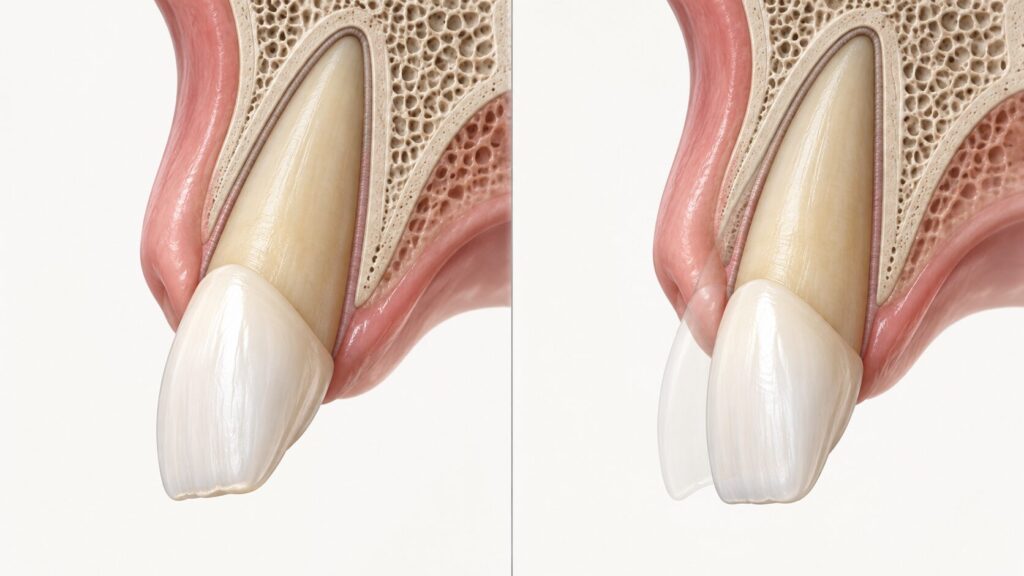
Can Protruding Teeth Be Fixed Without Braces?
Sometimes—but the answer depends on what “without braces” means.
Clear aligners may move protruding teeth without fixed metal or ceramic brackets when the planned movements are suitable for aligner treatment. They are still orthodontic appliances and must be professionally planned and monitored.
Cosmetic treatments such as bonding, veneers, crowns or enamel reshaping may change the visible contour of a tooth. However, they do not move the tooth root or correct the relationship between the upper and lower jaws. The medically reviewed Cleveland Clinic overjet guidance similarly explains that cosmetic procedures can camouflage appearance but do not correct the underlying bite condition.
Trying to push teeth backward manually or using unsupervised devices is not a safe substitute for treatment. Tooth movement affects the roots, gums and supporting bone and therefore requires diagnosis and monitoring.
Is Front-Tooth Reshaping the Same as Straightening?
No. Reshaping and orthodontic straightening address different problems.
Minor enamel contouring may smooth an uneven edge or make a slightly large tooth appear more proportionate. It cannot reliably correct a front tooth that is significantly tilted, rotated or positioned too far forward. Because removed enamel does not grow back, reshaping must be conservative and performed only after a dental assessment.
Searches for big front teeth reshaping cost often combine two different concerns:
- The tooth may genuinely appear wider or longer than nearby teeth.
- The tooth may look large because it projects forward or sits out of alignment.
In the second situation, moving the tooth may address the concern more appropriately than removing enamel. Some patients may ultimately benefit from coordinated orthodontic and restorative care, but that decision should be based on tooth proportions, enamel thickness, bite and long-term dental health.
What Affects Protruding Teeth Treatment Cost?
There is no single standard protruding teeth treatment cost because plans can differ substantially. Important cost factors include:
- Whether the concern is dental, skeletal or both
- The amount and type of tooth movement required
- Whether only the front teeth or the complete bite must be treated
- The chosen appliance
- Whether additional appliances are needed
- The complexity and anticipated length of care
- Required diagnostic records and monitoring
- Whether treatment is coordinated with restorative care or jaw surgery
- Insurance coverage and available payment arrangements
A minor alignment concern and a comprehensive bite correction should not be expected to have the same fee. Similarly, the price of enamel contouring cannot be used to estimate the cost of orthodontic treatment because these procedures accomplish different things.
A personalized quote should follow an examination and treatment plan. Patients comparing broader teeth straightening options should consider not only the initial fee but also the diagnosis, treatment objectives, supervision, retention plan and what is included in the quoted cost.
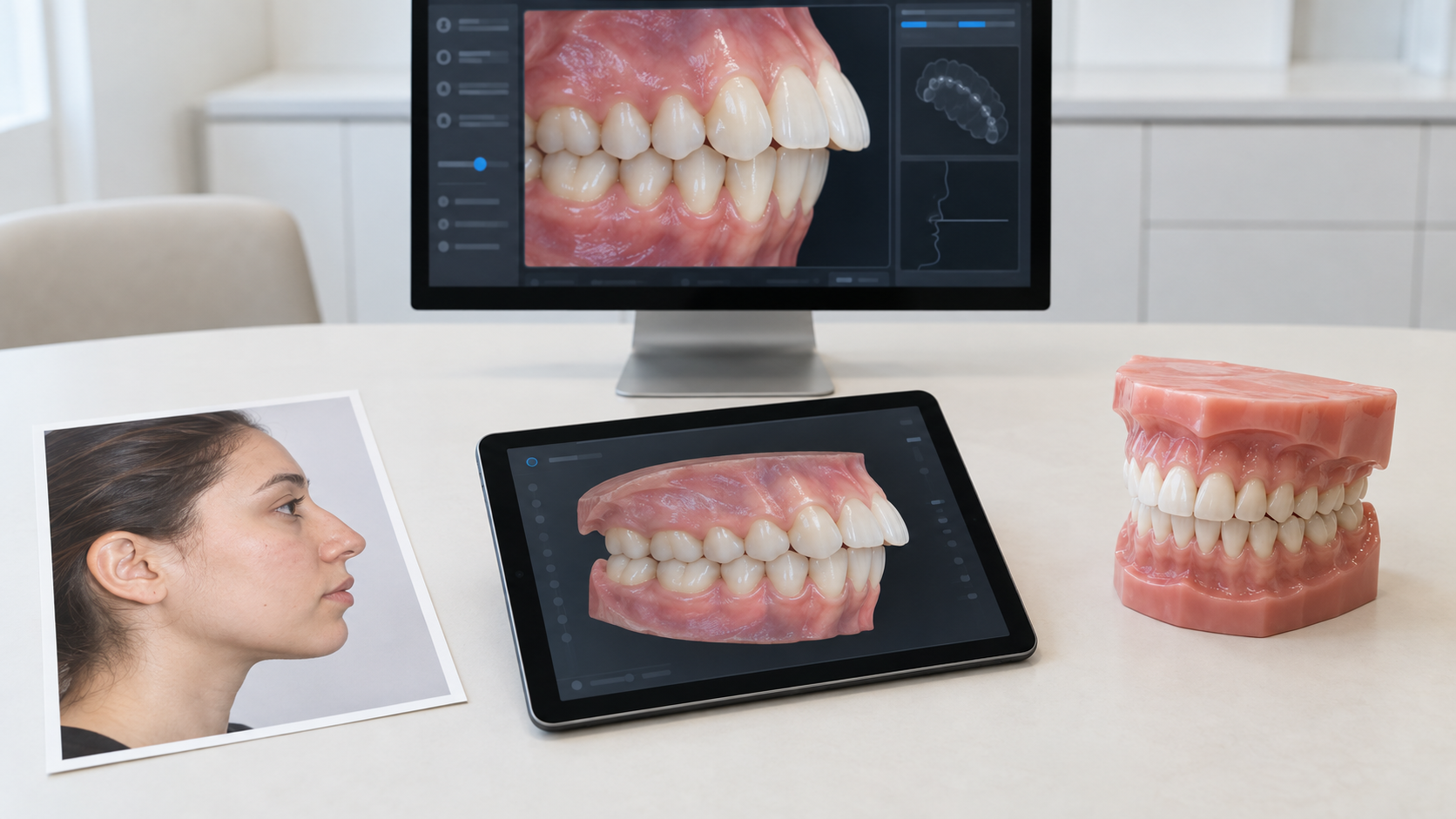
How Does an Orthodontist Choose the Right Treatment?
An orthodontist evaluates more than the visible front teeth. The assessment may include:
- The horizontal and vertical relationship of the front teeth
- Tooth angulation and root position
- Crowding and available space
- Upper- and lower-jaw relationships
- Facial profile and lip closure
- Gum and supporting-bone health
- Growth status in children and teenagers
- Previous dental work
- Oral habits and patient treatment preferences
Photographs, digital scans and radiographs may be needed to understand the teeth and jaws. The NHS overview of orthodontic assessment and braces likewise notes that assessment may include examining the teeth and jaws and taking scans, photographs or X-rays.
This process helps distinguish a straightforward alignment concern from a bite or jaw problem requiring a more comprehensive plan.
What Should You Do If Your Upper Front Teeth Protrude?
Arrange an orthodontic assessment if the appearance or position of your front teeth concerns you, if your lips do not close comfortably, or if the bite affects chewing or cleaning. Children with visibly prominent front teeth may also benefit from timely evaluation, even when the initial recommendation is monitoring rather than treatment.
Forward teeth can often be improved, but the safest plan depends on why they protrude. York Orthodontics can evaluate the teeth, bite and jaw relationship and explain which options are appropriate. Patients in Thornhill and North York can contact York Orthodontics to request an individualized consultation.
FAQs
Limited top teeth straightening may be possible in selected cases, but moving only the upper teeth can alter the bite. An orthodontist must check how both arches meet before recommending treatment limited to one arch.
No. Protruding teeth usually describe overjet, which is horizontal. An overbite is the vertical overlap of the upper and lower front teeth, although both conditions can occur together.
Clear aligners can treat some cases, but suitability depends on the amount of protrusion, available space, root movement and jaw relationship. More complex cases may require attachments, elastics, fixed braces or another treatment approach.
Minor contouring may change tooth shape, but it does not move the tooth or correct the bite. Removing enamel from a tooth that only appears large because it sits forward may not address the real cause.
Treatment time depends on the type and severity of misalignment, the movements required, the appliance and patient cooperation. A reliable estimate can only be provided after diagnostic assessment and treatment planning.
No. Treatment depends on function, injury risk, oral health, bite effects and the patient’s goals. Some mild cases may be monitored, while others benefit from active treatment.